Tuesday, April 12, 2011

Ford Crafts 2011

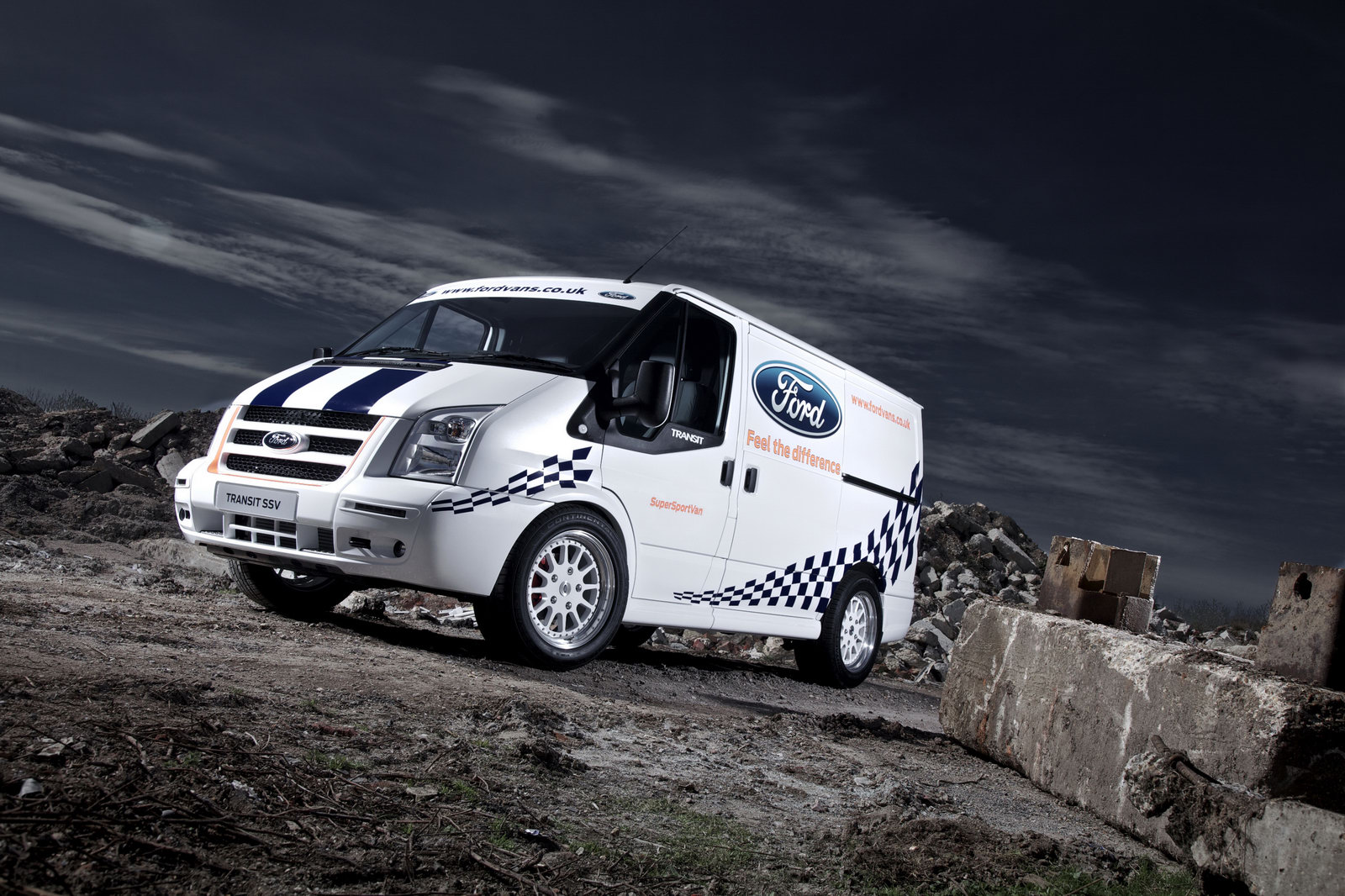
Continuing a tradition that dates back to the 1970’s with the creation of the GT40-based Supervan 1, Ford has lifted the wraps off the next evolution of its SportVan bloodline, the one-off Transit SuperSportVan (SSV). Revealed on Tuesday at the Commercial Vehicle Show at Birmingham’s NEC in the UK, the SSV combines the smallest body available in the Transit lineup with the biggest diesel in the range.
Ford’s flagship 3.2-litre inline-five turbo diesel engine was shoehorned into a short wheelbase Transit, for maximum power-to-weight ratio. The 3.2 TDCi unit, normally found in bigger Transit models like the 4.25 tonnes Transit Jumbo, delivers 200-horsepower and a maximum torque of 470Nm (346.7 lb-ft) at 1700-2500 rpm. The inline-five is hooked up to a six-speed gearbox.
In comparison, the standard Transit SportVan is based on the popular 260, short wheelbase model with front wheel drive, a 140HP 2.2-litre TDCi diesel engine and a six-speed transmission.
Aside from the powertrain changes, the Transit SSV features several exterior upgrades such as the Le Mans-style bonnet stripes, twin exhausts, deep-dish white alloy wheels wrapped around low profile 235/45 tires, front and rear lower spoilers, side skirts and extended wheel arches.
Steve Clary, commercial vehicles director, Ford of Britain, had this to say about the SSV: "[The] Transit has a strong reputation for its robustness and practicality. We wanted to add some contemporary fun and also showcase our engineers’ skill and enthusiasm. SuperSportVan demonstrates just how far you can go with a white Transit van by mixing and matching regular technology in a different way."
Ford was quick to point out that the Transit SSV is a one-off study and that is has no plans to present a production version.


Read more In Cars

2012 Cadillac SRX

Less than two years after the market introduction of the new Cadillac SRX in North America in the summer of 2009, and General Motors has gone ahead and improved its premium crossover for the 2012 model year with a more powerful six-cylinder engine and additional equipment features.
The highlight for the 2012 Cadillac SRX is of course the new 3.6-liter direct-injected V6 engine with 300HP and 260 lb.-ft. (353 Nm) of torque, which replaces the current 3.0-liter direct-injected V6 engine with 265HP and 223 lb.-ft (302 Nm).
In addition to the higher output, GM says the new engine has a wider rpm range for its maximum torque while it also adds FlexFuel capability, meaning it can use either gasoline, E85 ethanol or any combination of the two. Performance figures and fuel economy ratings have not yet been finalized.
Other improvements on the 2012 model year SRX include standard Bluetooth phone connectivity on all models, a heated steering wheel on the luxury, performance and premium trim levels and door lock switches on the driver and passenger door panels. In addition, the 2012 SRX gains a new machined-face finish on the 20-inch wheels, which are standard on performance and premium trim levels.
The new SRX, which will be offered in both front-wheel drive and all-wheel drive versions, will arrive at Cadillac dealerships in late summer with pricing to be announced closer to the start of production.


\


Read more In Cars

Monday, April 11, 2011

LIfestyle Sports : Volvo Ocean Race


Hyundai ECCOV


Renault Twizzy Ready For Road !


BMW Hires Frank Weber, Former Lead Engineer for the Chevy Volt

In a move that further solidifies BMW's commitment to electric cars, they have just hires Frank Weber, former head engineer for the Chevy Volt. Frank will report to Klaus Draeger, BMW's head of R&D

This move is a little surprising because in the past, BMW has rarely hired top people from other auto makers, electing instead to train and promote from within. In my opinion, this is an example of how important BMW feels it is to accelerate their electric car line and not fall behind in the race to bring a wide range of electric cars and plug in hybrids to their showrooms.

What I find particularly interesting is that there have been a lot of rumors around that BMW will be offering a range extender for the i3 shortly after the original BEV version is released in 2013. I'm hearing a lot of talk about a three cylinder, turbo charged engine as being the suspected powerplant for such a set up. This would make the i3 very similar to the Volt so in that regard Mr. Weber's experience can make an immediate impact on the development of the i3.

Wednesday, April 6, 2011

1,000 Charges and Still Going Strong!


Recently I passed the 1,000th recharge milestone with my MINI-E. That's considerable when you realize I have only had the car about 660 days so far. I've put 54,000 miles on it so that's over 80 miles per day, every single day I've had it. Obviously I haven't driven it every single day, so the days I have driven it I've probably averaged above 90 miles per day. That's a lot of charging, more than 1.5 times per day actually. Actually, the car is such a pleasure to drive, I find myself using it for everything I can, whether it be personal or for business use.

Those of you that follow this blog know that I occasionally write posts about my experiences for sites like Edmunds, AllCarsElectric and most often, Plugincars.com. I was talking to Brad Berman, editor of plugincars recently and he asked me if I would write a post on my range throughout the year in different temperatures. I was actually working on just that to post here, and planned to post it once I hit my 1,000th recharge. So instead of a full post here about it, I put it up on the plugincars website, that way it will reach an even greater audience than here, and give more people a chance to see how the car has performed. You can jump to the full post HERE.

A lot of people ask me about the range in extreme heat and cold, and whether or not I am beginning to notice battery degradation now that I have over 50,000 miles on it. I really haven't noticed any degradation, but my data seems to show that it is beginning to happen, as the second year data shows slightly less range that the first year throughout almost all temperature ranges.What the real usable life of a EV's battery pack is still debatable. There just aren't enough of them out there that are using the newer lithium ion chemistries that have been driven enough miles and charged enough times to have reliable data on, so I'm sure a lot of people are interested in the data that I've accumulated over the past 22 months.

Remember, the MINI-E is a prototype test car, and does not have a sophisticated thermal management system. The passive thermal management system it employs is really primitive, making this car particularly vulnerable to weather extremes. BMW will be using an active thermal management system on both the ActiveE and the i3, based on lessons learned from the MINI-E trial lease program: Here's what I've observed: